
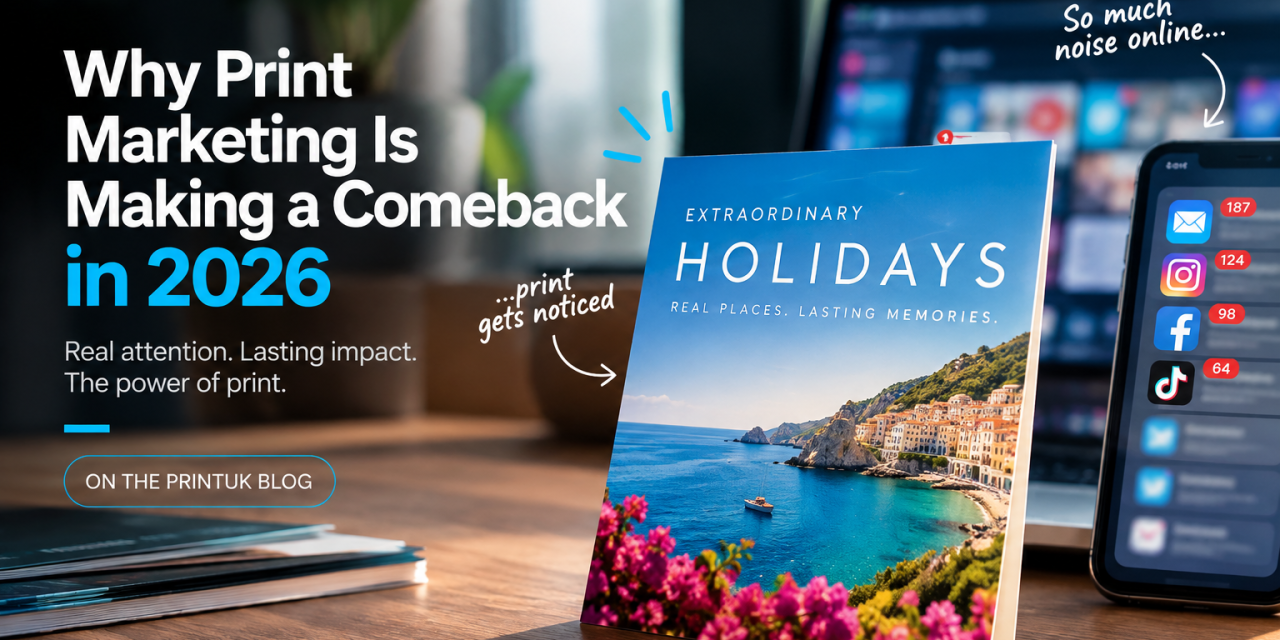
For years, businesses were told that the future of marketing was digital.
Email replaced direct mail. Social media replaced brochures. Websites replaced catalogues. And businesses increasingly moved their marketing budgets towards channels that could be tracked, targeted and optimised with a few clicks.
But in 2026, something interesting is happening.
Print marketing is becoming valuable again.
Not because businesses are abandoning digital marketing, but because physical marketing can do something increasingly difficult online: capture someone’s undivided attention.
With inboxes overflowing, social feeds moving at incredible speed and online advertising becoming increasingly competitive, a well-designed piece of printed marketing can feel surprisingly distinctive.
And the numbers support the idea that print still has plenty of life left in it.
The problem with digital marketing
Digital marketing is incredibly powerful. It allows businesses to reach enormous audiences, target specific demographics and measure almost every interaction.
But that accessibility is also its biggest weakness.
Your potential customer may see dozens of adverts while scrolling through social media. They may receive hundreds of emails every month. They are constantly being presented with videos, notifications, pop-ups, banners and sponsored content.
The result?
Attention has become one of the most valuable commodities in marketing.
Print gives businesses another way to compete for it.
A brochure sitting on a desk isn’t competing with 15 other browser tabs.
A postcard through the letterbox isn’t competing with an Instagram Reel.
A beautifully produced catalogue can be picked up, browsed and shared.
And unlike a digital advert that disappears as soon as someone scrolls past it, physical marketing can remain in the home or workplace for days or weeks.
Direct mail is still getting attention
One of the clearest examples of this is direct mail.
According to recent JICMAIL data, an average UK direct mail item received around 143 seconds of attention during Q4 2025 and remained in the household for an average of 7.4 days.
That is a remarkable amount of opportunity from something as simple as a physical piece of printed communication.
Even more interestingly, physical mail isn’t necessarily replacing digital behaviour.
It can encourage it.
Recent JICMAIL figures indicate that 9.7% of mail prompted a website visit, demonstrating how physical and digital marketing can work together rather than existing as competing channels.
This is where modern print marketing becomes particularly interesting.
Print and digital work better together
The most effective print campaigns in 2026 aren’t necessarily trying to keep customers offline.
They’re doing the opposite.
A printed piece can be the starting point for a digital journey.
For example:
Postcard → QR code → landing page → offer → online purchase
Or:
Brochure → product page → enquiry form → sales conversation
Or:
Direct mail → personalised URL → online booking
The printed piece captures attention and creates the initial interaction, while digital channels provide the convenience, information and measurement that modern marketers expect.
QR codes have therefore become a particularly useful bridge between physical and digital marketing.
A QR code can take someone directly from a printed brochure, flyer, poster or mailer to a specific webpage, promotion, video or booking page.
The important thing is to give the QR code a reason to be scanned.
“Scan here” is rarely compelling.
“Scan to claim your 15% discount” is considerably more interesting.
Personalisation is changing printed marketing
Another reason print is becoming more effective is personalisation.
Traditional print marketing often involved producing thousands of identical leaflets, brochures or mailers.
Modern printing technology allows businesses to take a very different approach.
Variable data printing means different pieces within the same print run can contain different names, offers, images, locations or messages.
Imagine a national retailer sending customers a catalogue where:
- The customer’s name appears on the cover
- Products are selected based on previous purchases
- The nearest store is highlighted
- The offer is relevant to their location
- A QR code takes them to a personalised landing page
The physical format stays the same, but the experience becomes much more relevant.
And relevance is what makes marketing work.
Premium print can make a brand feel premium
There is another area where print has a major advantage: physical perception.
You can tell someone that your business is premium.
Or you can give them something that feels premium.
Paper stock, weight, texture, colour reproduction, finishing and format can all influence how someone perceives a brand.
A luxury property brochure printed on lightweight paper sends a very different message from one produced on a substantial premium stock with sophisticated finishing.
The same applies to:
- Restaurant menus
- Corporate brochures
- Product catalogues
- Business cards
- Presentation folders
- Invitations
- Packaging
- Event materials
- Sales literature
Print is tangible.
And because it is tangible, the quality of the physical object becomes part of the marketing message.
Sustainability is becoming part of the conversation
Sustainability is another major consideration for businesses choosing print in 2026.
The answer isn’t simply to stop printing.
Instead, businesses are increasingly looking at printing more intelligently.
That can mean:
- Choosing responsibly sourced paper
- Using recycled stocks where appropriate
- Reducing unnecessary quantities
- Designing materials that have a longer useful life
- Using targeted rather than blanket distribution
- Combining print with digital information
- Producing shorter, more relevant print runs
The goal should be less unnecessary waste rather than simply less print.
A well-targeted printed campaign can be considerably more useful than thousands of generic pieces that were never relevant to the recipient.
Print can make your brand memorable
Perhaps the biggest reason print continues to work is simple:
People remember things they interact with physically.
Think about the printed materials you encounter in everyday life.
A business card handed to you at a meeting.
A restaurant menu.
A beautifully designed product catalogue.
A postcard from a company you’ve bought from before.
A brochure you picked up at an event.
These objects can become physical reminders of a brand.
And that matters because marketing isn’t just about generating an immediate sale.
It’s about building recognition.
When someone needs your product or service three months from now, you want your brand to be one of the names they remember.
The future isn’t print versus digital
The biggest misconception is that businesses have to choose between print and digital.
They don’t.
The strongest campaigns increasingly combine the two.
Digital marketing is excellent at targeting, speed, automation and measurement.
Print is excellent at physical presence, attention, brand perception and creating something people can hold onto.
Put them together and you get something considerably more powerful.
For example, a campaign could look like this:
1. Target a specific audience using digital advertising.
2. Send a personalised printed mailer to the most valuable prospects.
3. Use a QR code to take recipients to a dedicated landing page.
4. Follow up with email marketing.
5. Retarget website visitors through digital advertising.
6. Measure responses and use the data to improve the next print run.
Suddenly, print isn’t an isolated marketing channel.
It’s part of an integrated customer journey.
So, is print marketing making a comeback?
In reality, print never really disappeared.
What’s changing is how businesses use it.
The era of printing huge quantities of generic marketing materials simply because “that’s what we’ve always done” is disappearing.
In its place is a smarter approach:
Better targeting.
Better design.
Better print quality.
Better personalisation.
Better integration with digital.
Better measurement.
That is the opportunity for businesses in 2026.
Print doesn’t need to replace your digital marketing strategy.
It can make it stronger.
And at a time when everyone is fighting for attention online, putting something genuinely good into someone’s hands can be one of the most effective ways to stand out.
Ready to make your next campaign more memorable?
Whether you’re looking for brochures, leaflets, flyers, direct mail, booklets, catalogues, business stationery or high-volume commercial print, choosing the right format, stock and finish can make a significant difference to the final result.
At PrintUK, we combine commercial print expertise with high-quality production to help businesses turn great ideas into print that gets noticed.
Explore our range of printing services and discover what print could do for your next campaign. PrintUK.com

.jpg)
.jpg)